8 min read · Filed under: Recovery, Foundations, Anti-Inflammatory
N-Acetyl Cysteine has an identity crisis. In hospitals, it's the standard treatment for acetaminophen overdose — intravenous NAC can save your liver within hours of a toxic dose. In supplement aisles, it's sold as antioxidant support. In psychiatric research, it's being studied for OCD, addiction, and compulsive behavior.
These aren't three different drugs. They're three consequences of a single mechanism: NAC provides the rate-limiting amino acid for glutathione synthesis. Everything NAC does in your body flows from that one biochemical fact.
But the most interesting application — glutamate modulation in reward circuits — was discovered almost by accident, and it operates through a pathway that has nothing to do with antioxidants.
The Glutathione Bottleneck
Glutathione (GSH) is the most abundant intracellular antioxidant in the human body. It's a tripeptide — three amino acids linked together: glutamate, cysteine, and glycine. Your cells synthesize it continuously, using it to neutralize reactive oxygen species, detoxify foreign compounds, regenerate other antioxidants (including vitamins C and E), and support immune cell function.
The synthesis pathway has a bottleneck, and it's cysteine. Not because cysteine is rare in the diet, but because free cysteine is rapidly oxidized in the bloodstream and poorly transported into cells. Of the three substrates, cysteine is almost always the limiting factor.
NAC solves this by providing cysteine in an N-acetylated form. The acetyl group protects the cysteine from oxidation during transit, allowing it to reach cells intact. Once inside, enzymes remove the acetyl group, liberating free cysteine for incorporation into the glutathione synthesis pathway.
The distinction matters: when you supplement NAC, you're not adding an antioxidant directly. You're removing the production constraint on your body's own antioxidant factory. And because glutathione levels are homeostatically regulated — your cells won't produce more than they need just because substrate is available — NAC is most effective when glutathione is genuinely depleted. That happens during oxidative stress, heavy alcohol consumption, intense exercise, chronic illness, and aging.
What This Means for Your Liver
The liver contains the highest concentration of glutathione in the body, and for good reason — it's the primary site of xenobiotic metabolism. Phase II detoxification reactions rely on glutathione conjugation to render toxic metabolites water-soluble for excretion. When you overwhelm this system (as in acetaminophen overdose, where the toxic metabolite NAPQI exhausts hepatic glutathione stores), liver cells begin to die.
NAC's role as an overdose antidote works precisely because it replenishes the cysteine pool, allowing the liver to regenerate glutathione fast enough to keep up with toxin production. The same mechanism, at lower intensity, supports everyday hepatic function in people with high oxidative loads — frequent travel, alcohol consumption, environmental toxin exposure, or chronic medication use.
The Glutamate Discovery Nobody Expected
In the early 2000s, researchers studying addiction neurobiology stumbled onto something that changed NAC's trajectory entirely. NAC was normalizing glutamate levels in the nucleus accumbens — a brain region central to reward processing and compulsive behavior — through a mechanism completely unrelated to glutathione.
The pathway is called the cystine-glutamate antiporter, or system Xc-. It's a membrane transport protein found on astrocytes in the brain. The antiporter works as an exchanger: it imports one molecule of cystine (the oxidized dimer of cysteine) into the cell while exporting one molecule of glutamate into the extracellular space.
This extracellular glutamate activates presynaptic metabotropic glutamate receptors (mGluR2/3), which function as autoreceptors — they tell the presynaptic neuron to reduce its glutamate release. It's a feedback loop: glial glutamate export via system Xc- keeps synaptic glutamate release in check.
In addiction and compulsive disorders, this system is downregulated. System Xc- activity drops, extracellular glutamate falls, the mGluR2/3 brake disengages, and synaptic glutamate surges unchecked. The result is hyperexcitability in reward circuits — the neurochemical substrate of craving and compulsive behavior.
NAC, by providing cysteine (which is rapidly oxidized to cystine in the extracellular space), feeds the cystine side of the antiporter. More cystine imported means more glutamate exported, restoring extracellular glutamate tone and re-engaging the inhibitory feedback.
This mechanism has driven a wave of clinical trials. NAC has shown promising results in reducing symptoms of trichotillomania, skin picking, gambling disorder, cannabis dependence, and cigarette craving. The evidence for OCD is mixed but encouraging — several small trials showed significant symptom reduction when NAC was added to standard SSRI therapy. The consistent thread is glutamate dysregulation in corticostriatal circuits.
Dosage and Practical Considerations
Standard oral dosing is 600 to 1,800 mg daily, typically divided into two doses. NAC has relatively low oral bioavailability (roughly 6 to 10%), but this is sufficient to produce clinically meaningful increases in both plasma cysteine and intracellular glutathione. Taking it on an empty stomach improves absorption.
Side effects are mild and primarily gastrointestinal — nausea and loose stool at higher doses. The compound has a sulfurous smell and taste that some people find unpleasant.
One important interaction: NAC can potentiate the hypotensive effects of nitroglycerin and other nitrate medications. If you're on cardiovascular medication, check with your prescriber before supplementing.
There's a theoretical concern — not yet clinically validated — that long-term, high-dose NAC could interfere with physiological reactive oxygen species signaling. ROS aren't purely destructive; at low levels, they serve as signaling molecules for exercise adaptation, immune function, and cellular stress responses. Whether chronic NAC supplementation blunts these beneficial ROS functions in healthy people remains an open question. The pragmatic approach is moderate doses and periodic cycling, especially if you're also supplementing other antioxidants.
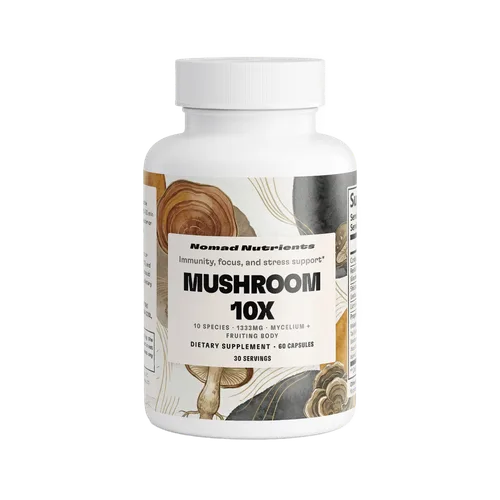
Curcumin anti-inflammatory + 10-mushroom immune + 92 trace minerals = Immunity
Turmeric Gummies target inflammation daily. Mushroom 10X delivers broad-spectrum immune training, rotating with Chaga during off-periods. Sea Moss provides the mineral foundation.
The Honest Frame
NAC is a workhorse, not a star. It doesn't produce a subjective feeling. Its effects are infrastructural — maintaining the glutathione pool that every detoxification and antioxidant system in your body depends on, while quietly normalizing glutamate signaling in circuits that drive compulsive behavior.
For people who travel frequently (altitude and air quality drive oxidative stress), consume alcohol regularly (hepatic glutathione demand), or notice compulsive patterns they'd like to attenuate — NAC addresses the underlying biochemistry without drama. It's essential plumbing. Not glamorous. Not optional.
References
- Mokhtari V, et al. "A review on various uses of N-acetyl cysteine." Cell Journal, 2017.
- Dean O, et al. "N-acetyl cysteine in psychiatry: current therapeutic evidence and potential mechanisms of action." Journal of Psychiatry and Neuroscience, 2011.
- Baker DA, et al. "Neuroadaptations in cystine-glutamate exchange underlie cocaine relapse." Nature Neuroscience, 2003.
- Grant JE, et al. "N-acetyl cysteine, a glutamate modulator, in the treatment of trichotillomania: a double-blind, placebo-controlled study." Archives of General Psychiatry, 2009.
- Atkuri KR, et al. "N-Acetylcysteine — a safe antidote for cysteine/glutathione deficiency." Current Opinion in Pharmacology, 2007.