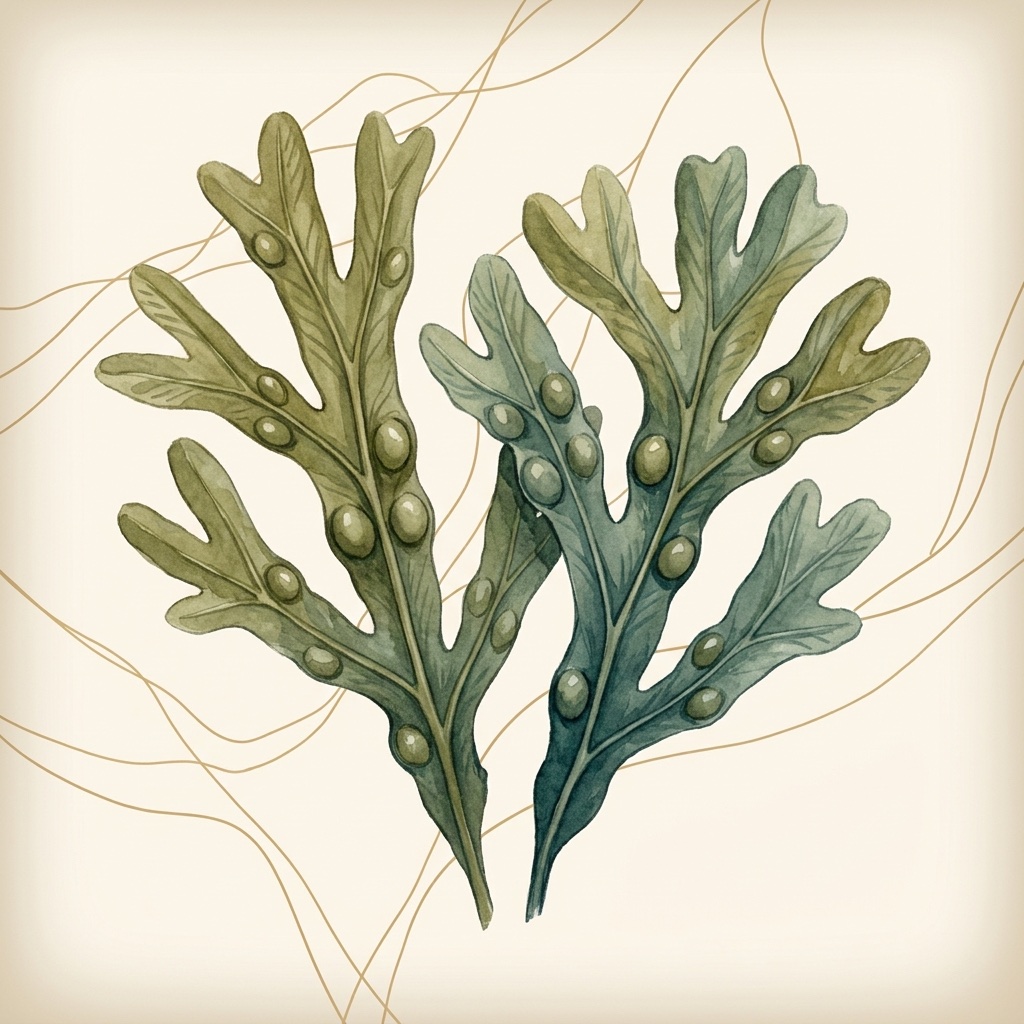
Bladderwrack (Fucus vesiculosus) is a brown seaweed that's been used alongside sea moss in Caribbean and Celtic traditional medicine for centuries. The pairing isn't arbitrary — the two organisms provide complementary nutrient profiles and bioactive compounds.
Bladderwrack's most significant contribution is iodine — it's one of the richest natural sources, containing 300–600 mcg per gram of dried material. Iodine is essential for thyroid hormone synthesis (T3 and T4), which regulates basal metabolic rate, thermoregulation, and cognitive development. Iodine deficiency remains one of the most common micronutrient deficiencies globally, even in developed nations — particularly among people who don't consume iodized salt or regular seafood.
Beyond iodine, bladderwrack contains:
Fucoidan — a sulfated polysaccharide with demonstrated anti-inflammatory, antiviral, and immunomodulatory properties. Fucoidan has been shown to inhibit selectin-mediated leukocyte adhesion (reducing inflammatory cell recruitment), modulate complement activation, and exhibit antiviral activity against several enveloped viruses. The fucoidan research is primarily preclinical, but the mechanism — blocking inflammatory cell trafficking — is pharmacologically well-characterized.
Fucoxanthin — a carotenoid pigment unique to brown seaweeds with antioxidant activity and emerging evidence for metabolic effects. Animal studies have shown fucoxanthin increases expression of uncoupling protein 1 (UCP1) in white adipose tissue, potentially increasing thermogenic energy expenditure. Human data is limited but the mechanism is biologically distinct from other carotenoids.
Alginic acid — another polysaccharide that forms a gel in the stomach, which has been used clinically as a physical anti-reflux barrier (the mechanism behind commercial alginate-based reflux medications like Gaviscon).
The sea moss + bladderwrack combination provides a broader spectrum than either alone: sea moss contributes the mineral matrix and mucilaginous polysaccharides; bladderwrack adds concentrated iodine, fucoidan, and fucoxanthin. Traditional preparations typically combined the two at roughly a 2:1 or 3:1 ratio (sea moss to bladderwrack), which provides iodine in meaningful but not excessive amounts.