7 min read · Filed under: Mood, Sleep, Neurotransmitters
Everyone knows serotonin matters for mood. Fewer people understand that the amino acid their body uses to make serotonin — tryptophan — mostly doesn't become serotonin at all. The metabolic fork where tryptophan's fate is decided is one of the most consequential junctions in human biochemistry, and it explains why 5-HTP exists as a supplement category in the first place.
5-Hydroxytryptophan bypasses the rate-limiting step and the competing pathway that diverts most dietary tryptophan away from serotonin synthesis. That's not a marketing claim. It's an enzymatic fact with real implications for mood, sleep, and — critically — for drug interactions that can become dangerous.
The Tryptophan Fork: Where 95% Goes Somewhere Else
Tryptophan is an essential amino acid — your body can't synthesize it, so it must come from dietary protein. Once absorbed, tryptophan enters the bloodstream and faces a metabolic fork that determines its fate.
Path 1: Serotonin synthesis. Tryptophan is hydroxylated by the enzyme tryptophan hydroxylase (TPH) to produce 5-HTP, which is then decarboxylated by aromatic amino acid decarboxylase (AADC) to produce serotonin (5-HT). Serotonin can then be converted to melatonin via N-acetyltransferase and HIOMT in the pineal gland. This is the pathway everyone thinks of when they think of tryptophan.
Path 2: The kynurenine pathway. Tryptophan is oxidized by indoleamine 2,3-dioxygenase (IDO) or tryptophan 2,3-dioxygenase (TDO) to produce N-formylkynurenine, which is rapidly converted to kynurenine. From there, it branches further into quinolinic acid (neurotoxic, NMDA receptor agonist), kynurenic acid (neuroprotective, NMDA receptor antagonist), and ultimately NAD+ — the essential coenzyme for cellular energy metabolism.
Here's the critical number: under normal conditions, approximately 95% of dietary tryptophan is metabolized through the kynurenine pathway. Only about 1-5% enters serotonin synthesis. The kynurenine pathway is not a minor side route — it's the primary metabolic destination for tryptophan, driven by IDO and TDO activity.
This ratio gets worse under inflammatory conditions. Pro-inflammatory cytokines — particularly interferon-gamma, TNF-alpha, and IL-6 — upregulate IDO expression, pulling even more tryptophan into the kynurenine pathway and away from serotonin synthesis. This is the molecular link between chronic inflammation and depression: inflammation doesn't just correlate with low serotonin, it mechanistically drives it by diverting the precursor.

Why 5-HTP Bypasses the Bottleneck
5-HTP enters the serotonin synthesis pathway after the tryptophan fork. It doesn't compete with the kynurenine pathway because it's already past the IDO/TDO decision point. The enzyme that converts tryptophan to 5-HTP — tryptophan hydroxylase — is the rate-limiting step in serotonin synthesis. 5-HTP supplementation skips this step entirely.
Once ingested, 5-HTP is converted to serotonin by aromatic amino acid decarboxylase (AADC), an enzyme that is abundantly expressed and not typically rate-limiting. This means that exogenous 5-HTP is efficiently and rapidly converted to serotonin — unlike tryptophan, which must first compete for transport across the blood-brain barrier with other large neutral amino acids (leucine, isoleucine, valine, tyrosine, phenylalanine), then survive the 95% diversion to kynurenine, and then pass through the rate-limiting TPH step.
5-HTP also crosses the blood-brain barrier readily without requiring a competitive transport mechanism. It uses the same L-type amino acid transporter but without the competitive inhibition from branched-chain amino acids that limits tryptophan uptake. This is why a protein-rich meal — which raises blood levels of competing amino acids — can paradoxically reduce brain serotonin synthesis from tryptophan, but doesn't impair 5-HTP's central effects to the same degree.
The IDO-Inflammation Connection
The enzyme IDO (indoleamine 2,3-dioxygenase) deserves special attention because it sits at the intersection of immunology and neuropsychiatry in a way that has fundamentally changed how researchers think about depression.
IDO is induced by pro-inflammatory cytokines as part of the immune response. Its original evolutionary purpose is antimicrobial: by depleting tryptophan from the local environment, it starves intracellular pathogens (particularly parasites and certain bacteria) that depend on tryptophan for growth. This tryptophan depletion strategy is effective against infection, but the collateral damage is reduced substrate availability for serotonin synthesis.
In chronic inflammatory conditions — autoimmune disease, obesity, metabolic syndrome, chronic stress — IDO is persistently upregulated. The result is a chronic state of tryptophan diversion that simultaneously reduces serotonin availability and increases production of neurotoxic kynurenine metabolites (particularly quinolinic acid, an NMDA receptor agonist that can contribute to excitotoxicity).
This is why anti-inflammatory interventions sometimes improve depressive symptoms — they're reducing IDO activity and restoring tryptophan availability for serotonin synthesis. And it's why 5-HTP supplementation is mechanistically rational in inflammatory states: it bypasses IDO entirely, providing serotonin precursor regardless of inflammatory tryptophan diversion.
The SSRI Interaction: Serotonin Syndrome Risk
This is the section that matters most from a safety perspective. 5-HTP increases serotonin synthesis. SSRIs (selective serotonin reuptake inhibitors) prevent serotonin reuptake from the synaptic cleft, increasing its duration of action. Combining the two creates a risk of serotonin syndrome — a potentially life-threatening condition characterized by hyperthermia, muscle rigidity, autonomic instability, altered mental status, and in severe cases, seizures and death.
Serotonin syndrome occurs when synaptic serotonin levels exceed the capacity of regulatory mechanisms to maintain homeostasis. It's not theoretical — it's a documented clinical emergency that occurs with combinations of serotonergic agents. The risk extends beyond SSRIs to SNRIs, MAOIs, tramadol, triptans, and other serotonergic medications.
If you are taking any serotonergic medication, do not add 5-HTP without explicit guidance from your prescriber. This is not a soft recommendation. The pharmacological interaction is predictable from the mechanism, and the consequences can be severe.
Sleep vs. Mood: Dosing Strategy Diverges
5-HTP's applications for mood and sleep are both mediated by serotonin, but the optimal dosing strategies differ because the downstream pathways diverge.
For mood support: Serotonin's mood-regulating effects operate primarily through 5-HT1A and 5-HT2A receptors in the prefrontal cortex, amygdala, and raphe nuclei. These effects require sustained serotonin availability throughout the day. Clinical trials showing mood benefits typically use 150-300mg daily in divided doses (50-100mg two to three times daily), building effects over 2-4 weeks as serotonergic tone normalizes.
For sleep support: Serotonin's sleep effects are mediated through its conversion to melatonin in the pineal gland. This conversion is regulated by darkness — the enzyme N-acetyltransferase is activated by the absence of light input to the suprachiasmatic nucleus. Taking 5-HTP in the evening (100-300mg, 30-60 minutes before bed) provides substrate for melatonin synthesis during the window when the pineal gland is actively producing it. This is mechanistically different from taking exogenous melatonin — you're feeding the upstream precursor rather than bypassing the synthesis pathway entirely.
Some practitioners use a combined approach: lower doses during the day for mood support (50mg with meals) and a larger dose in the evening for sleep (100-200mg). This provides daytime serotonergic support while loading substrate for nocturnal melatonin production.
Peripheral Serotonin: The Gut Consideration
Approximately 90-95% of the body's serotonin is produced in the gut, not the brain. Peripheral serotonin regulates GI motility, platelet aggregation, and cardiovascular function. Because AADC (the enzyme that converts 5-HTP to serotonin) is expressed peripherally — particularly in the gut and kidneys — oral 5-HTP can increase peripheral serotonin levels as well as central levels.
This is why some people experience GI side effects (nausea, loose stool) when starting 5-HTP — the gut is responding to increased local serotonin production. Starting at a low dose (50mg) and titrating up over 1-2 weeks allows the GI system to adjust. Taking 5-HTP with food can also reduce GI symptoms, though it slightly delays absorption.
Some formulations include carbidopa or green tea catechins (EGCG) as peripheral AADC inhibitors — reducing peripheral conversion so more 5-HTP reaches the brain for central serotonin synthesis. This strategy, borrowed from Parkinson's disease treatment (where carbidopa is co-administered with L-DOPA to reduce peripheral dopamine conversion), can improve the central-to-peripheral ratio but is not standard in most over-the-counter formulations.
Dosage and Practical Considerations
Starting dose: 50mg once daily, preferably in the evening if sleep is the primary target.
Therapeutic range: 100-300mg daily, divided into 1-3 doses depending on the application (mood vs. sleep).
Upper limit: Most clinical research uses doses up to 300mg daily. Higher doses have not shown proportionally greater benefit and increase the risk of side effects, particularly GI symptoms and potential serotonin excess.
Onset: Sleep effects often appear within the first week. Mood effects typically require 2-4 weeks of consistent dosing, consistent with the time needed to establish new serotonergic tone.
Cycling: Some practitioners recommend cycling 5-HTP (5 days on, 2 days off, or 8 weeks on, 2 weeks off) to prevent downregulation of serotonin receptors. The clinical evidence for this practice is limited, but the theoretical rationale — avoiding compensatory receptor changes from sustained serotonin elevation — is pharmacologically sound.
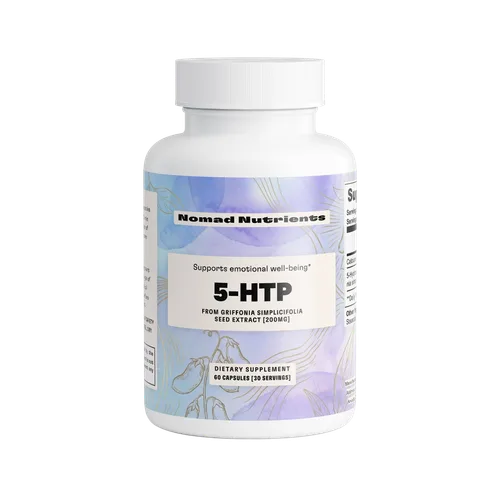
Source: Supplemental 5-HTP is derived from the seeds of Griffonia simplicifolia, a West African shrub. Quality varies between suppliers — third-party testing for purity and the absence of Peak X contaminants (associated with eosinophilia-myalgia syndrome in contaminated L-tryptophan supplements in the late 1980s) is important when selecting a product.
The Honest Frame
5-HTP is not an antidepressant. It's a serotonin precursor that bypasses the metabolic bottleneck and competing pathway that prevent most dietary tryptophan from becoming serotonin. The biochemistry is clean and well-understood. The clinical data supports modest but meaningful effects on mood and more consistent effects on sleep quality.
The critical nuance is the SSRI interaction. 5-HTP occupies a pharmacological space that overlaps with prescription serotonergic medications, and combining them without medical supervision is genuinely dangerous. This isn't the usual supplement-caution boilerplate — serotonin syndrome is a medical emergency with a mechanistically predictable cause.
For people not on serotonergic medication who want to support serotonin synthesis through its most efficient precursor — particularly in the context of inflammatory states that divert tryptophan away from serotonin — 5-HTP is one of the better-evidenced options available. It does one thing, through one mechanism, and the pathway is transparent enough to dose intelligently.
References
- Birdsall TC. "5-Hydroxytryptophan: a clinically-effective serotonin precursor." Alternative Medicine Review, 1998.
- Schwarcz R, et al. "Kynurenines in the mammalian brain: when physiology meets pathology." Nature Reviews Neuroscience, 2012.
- Dantzer R, et al. "From inflammation to sickness and depression: when the immune system subjugates the brain." Nature Reviews Neuroscience, 2008.
- Javelle F, et al. "Effects of 5-hydroxytryptophan on distinct types of depression: a systematic review and meta-analysis." Nutrition Reviews, 2020.
- Shell W, et al. "A randomized, placebo-controlled trial of an amino acid preparation on timing and quality of sleep." American Journal of Therapeutics, 2010.